Swim Workouts That Make Sense: Structure Your Training for Speed, Endurance & Progress
If your pool sessions feel like a monotonous grind of counting tiles with little progress to show for it, you’re experiencing what frustrates millions of swimmers. Whether you’re a fitness enthusiast, a triathlete, or a self-coached masters swimmer, the leap from casual swimming to purposeful, progress-driven training is unlocked by mastering three fundamental concepts: time, distance, and pace.
This comprehensive guide serves as your definitive roadmap. Drawing on established exercise physiology and coaching methodologies from organizations like the American College of Sports Medicine (ACSM) and the American Swimming Coaches Association (ASCA), we’ll dismantle the complexity. You’ll learn to construct workouts that translate directly to your goals—whether that’s a faster 50m sprint, completing your first mile, or conquering the swim leg of a triathlon with confidence. This isn’t about following random routines; it’s about becoming the architect of your own swimming success.
If you’re new to structured swim workouts, it helps to start with a clear overview of swimming training principles, planning, and progress tracking, which I explain in detail in my main swimming training guide.
Effective training begins with speaking the language of metrics. These are not just numbers; they are the levers you pull to create specific physiological adaptations.
Time: This encompasses total session duration and interval timing. It’s the framework of your workout. Managing your rest intervals (e.g., taking 20 seconds vs. 30 seconds between repeats) is a primary tool for controlling intensity.
Distance: Measured in meters or yards, distance is your training volume. It’s the raw material of endurance. However, swimming 2,000 meters randomly is vastly different from swimming 8 x 250 meters with a specific pace goal—the structure dictates the outcome.
Pace: The crown jewel of swim metrics. Pace is your speed expressed as time per 100 meters/yards (e.g., 1:45/100m). Pace personalizes training. It moves you from subjective “hard” or “easy” efforts to objective targets. Knowing your threshold pace allows you to train your aerobic system without spilling into anaerobic fatigue, or to target your VO2 max with precision.
The Interrelationship: Imagine planning a road trip. Distance is the total miles. Time is how long you have to drive it. Pace is the speed you must average to arrive on time. In the pool, if your goal is to hold a 2:00/100m pace for 1,000 meters, you are prescribing a specific physiological challenge. Your watch or the pace clock becomes your dashboard, giving you real-time feedback on whether you’re “on pace” to achieve your workout’s goal.
You cannot effectively plan a journey without knowing your starting point. A baseline test replaces guesswork with data, allowing you to create personalized training zones. As a former collegiate swimmer and now an ASCA-certified coach, I’ve seen athletes shave seconds off their times simply by training at the correct paces instead of just “hard” paces.
Recommended Baseline Tests:
1. The Critical Swim Speed (CSS) Test – Your Metabolic North Star
CSS approximates your lactate threshold pace—the fastest speed you can maintain primarily using aerobic energy systems. It’s arguably the most useful single metric for a distance swimmer or triathlete.
Protocol: After a full warm-up, perform two all-out, consistent time trials: 400 meters and 200 meters. Record each time accurately. Rest fully (5-10 minutes) between efforts.
Calculation: CSS Pace per 100m = (400m time - 200m time) ÷ 2.
*Example: 400m = 6:40 (400 sec), 200m = 3:00 (180 sec). CSS = (400-180)/2 = 110 seconds = 1:50 per 100m.*
2. The T-20 or T-30 Test – A Simple Alternative
Swim as far as you can in 20 or 30 minutes, trying to maintain a steady, strong effort. Your average pace per 100m for this swim is an excellent indicator of your sustainable endurance pace.
Take Action Now: Input the results from your baseline test into our Swim Goal Tracker. This tool transforms your raw times into a structured plan. By entering your current pace, weekly distance, and a target goal, it calculates your required weekly progression, estimates your achievement timeline, and provides a personalized calorie expenditure estimate—turning a test result into an actionable roadmap.
Every effective session, from a brisk 30-minute fitness swim to a two-hour endurance grind, follows a tried-and-true architecture. This structure maximizes physiological benefit while minimizing injury risk and mental fatigue.
The Essential Workout Components (Detailed Breakdown)
| Component | % of Total Distance | Primary Physiological Purpose | Key Activities & Coaching Cues |
|---|---|---|---|
| Warm-Up | 10-15% | Prepare: Increase core temp, blood flow, joint mobility, and neuromuscular activation. | Easy swimming, gradual builds, technique drills (catch-up, fingertip drag). Focus: Feel the water. No speed. |
| Pre-Set / Drill Focus | 10-15% | Skill Reinforcement: Isolate and ingrain efficient movement patterns. | Use tools: kickboards for leg strength, pull buoys for arm focus, paddles for feel of water. Cue: "Technique before fatigue." |
| Main Set | 60-70% | Adaptation: The primary stimulus for physiological change (endurance, speed, power). | Structured intervals with defined distance, target pace, and rest. This is where the goal is achieved. |
| Cool-Down | 5-10% | Recovery Initiation: Lower heart rate, flush lactate, promote flexibility. | Very easy swimming, often with a different stroke. Focus: Relaxation and smoothness. |
Decoding Swim Set Notation
A set written as “5 x 100m @ 1:45, send-off on the 2:00” can be confusing. Let’s break it down:
5 x 100m: You will swim 100 meters, five times.
@ 1:45: Your goal is to swim each 100m in 1 minute 45 seconds.
Send-off on the 2:00: You start each new 100m every 2 minutes.
The Math: If you hit your 1:45 pace, you get 15 seconds rest. If you swim slower, you get less rest; faster, you get more. This style (interval training) enforces pace discipline.
Expert Insight: "The most common mistake I see is swimmers neglecting the warm-up and cool-down," says Michael Collins, a master's coach with 25 years of experience. "They jump straight into the main set, which limits performance potential and increases injury risk. That 10-15 minutes of preparation and recovery isn't optional—it's what makes the hard work in the middle both possible and productive."
Not all fast swimming is created equal. Training in specific physiological zones develops distinct energy systems. Use your CSS pace as the anchor for the following zones:
Recovery (RPE 2-3): Slower than CSS + 20 sec/100m. Purpose: Promotes circulation and recovery without stress. Feel: Easy, relaxed, conversational.
Aerobic Endurance (RPE 4-5): CSS + 10 to 15 sec/100m. Purpose: Builds aerobic base, increases mitochondrial density, teaches pace control. Feel: Steady, sustainable, moderate effort.
Threshold (RPE 6-7): At or near CSS pace. Purpose: Improves lactate clearance and tolerance; raises the speed you can sustain. Feel: "Comfortably hard," cannot hold a conversation.
VO2 Max / Anaerobic (RPE 8-9): CSS - 5 to 10 sec/100m. Purpose: Increases maximal oxygen uptake and top-end speed. Feel: Very hard, burning sensation, short duration efforts (50m-200m).
Sprint (RPE 10): All-out, maximal effort. Purpose: Develops neuromuscular power, race-start speed, and anaerobic capacity. Feel: Maximal exertion for ≤ 50m.
The Principle of Specificity: A 2021 review in the International Journal of Sports Physiology and Performance confirmed that endurance is best improved by training at or below threshold, while peak speed requires training at or above VO2 max intensities. Swimming everything at a moderate "hard" pace develops neither system optimally.
Swimming Workout From Theory to Practice
Here are three complete, goal-oriented workouts. For a version customized to your exact pool length, available time, and current fitness level, use our Swim Workout Calculator. It will adjust distances, rest intervals, and pacing to match your profile.
Workout A: The Aerobic Engine Builder (Beginner/Intermediate)
Goal: Increase sustainable speed and muscular endurance.
Total Distance: ~2,200m
Focus: Consistent pacing and technique under mild fatigue.
Warm-Up (400m): 200m easy free. 4 x 50m as: 25m kick on side / 25m swim.
Pre-Set (300m): 6 x 50m Drill/Swim. Odd: Fist drill (focus on forearm catch). Even: Smooth swim, focusing on high elbow.
Main Set (1,300m):
Endurance Ladder: 1 x 100m, 1 x 200m, 1 x 300m, 1 x 200m, 1 x 100m. Swim at your Aerobic Endurance Zone pace (CSS +10-15s). Take 30 seconds rest after each distance.
Active Recovery: 100m very easy choice stroke.
Cool-Down (200m): 200m easy, focusing on long, gliding strokes.
Workout B: Threshold & Power Mixer (Intermediate/Advanced)
Goal: Improve lactate tolerance and cruising speed.
Total Distance: ~3,000m
Focus: Holding tough pace on decreasing rest.
Warm-Up (500m): 300m easy swim. 8 x 25m build from easy to fast by the wall.
Pre-Set (400m): With a pull buoy: 4 x 100m as 50m focus on early vertical forearm / 50m strong swim. Rest 20s.
Main Set (1,800m):
Round 1: 4 x 100m at Threshold Pace (CSS). Rest 20s.
Round 2: 4 x 100m at Threshold Pace. Rest 15s.
Round 3: 8 x 50m at VO2 Max Pace (CSS -5s). Rest 30s.
Active Recovery: 200m easy.
Cool-Down (300m): 300m easy, mix strokes.
Workout C: Technique & Efficiency Focus (All Levels)
Goal: Refine stroke mechanics to save energy and increase speed.
Total Distance: ~1,800m
Focus: Mindful movement and feedback.
Warm-Up (300m): 200m easy. 100m choice of non-free stroke.
Drill Set (600m): Use a Finis Tempo Trainer or count strokes.
6 x 50m Catch-Up Drill (force full extension). Rest 15s.
6 x 50m Single-Arm Drill (3 left/3 right, isolate rotation). Rest 15s.
6 x 50m with paddles (focus on feeling a “full bucket” of water). Rest 15s.
Main Set (700m): 7 x 100m. Descend 1-5: #1 very easy (focus on one drill cue), gradually getting faster to #5 at a strong, controlled effort. #6 & #7 easy. Rest 25s.
Cool-Down (200m): 200m easy backstroke or breaststroke.
After your swim, track your results. Use the Pool Workout Tracker to log your total distance, average pace, and how you felt. Over time, its charts will reveal powerful trends—like your pace gradually dropping for the same heart rate, a clear sign of improved efficiency.
The Progression Principle – How to Avoid Plateaus in Swimming
The human body is remarkably adaptive. Doing the same workout repeatedly leads to diminished returns—the dreaded plateau. The solution is progressive overload: systematically increasing the training stress to force continued adaptation.
Apply the 10% Rule (with Flexibility): A general guideline is to not increase weekly volume by more than 10% at a time. However, progression isn’t just about distance. Every 3-4 weeks, change one variable in your key sets:
Increase Volume: Add 1-2 repeats to your main set. (e.g., go from 5 x 100m to 6 x 100m).
Increase Intensity: Hold a slightly faster pace for the same set. (e.g., hold CSS pace instead of CSS+10s).
Decrease Rest: Shorten your recovery interval by 5-10 seconds, increasing the set’s density and metabolic challenge.
Increase Complexity: Combine variables (e.g., do a “descending set” where each repeat gets faster).
The Role of Periodization: For long-term progress (e.g., peaking for a race season), structure your training into cycles:
Base Phase (4-6 weeks): Higher volume, lower intensity. Focus on endurance and technique.
Build Phase (4-6 weeks): Introduce threshold and VO2 max work. Intensity increases, volume may stabilize.
Peak/Taper Phase (1-3 weeks): Reduce volume dramatically, maintain race-pace intensity. Goal: arrive rested and sharp.
Recovery Phase (1 week): Very low volume and intensity. Essential for physical and mental regeneration.
Every effective swim workout fits into a bigger training system, where workouts, plans, and performance tracking work together as part of a structured swimming training approach.
Tracking, Analyzing, and Iterating in Swim Workout
Data is your compass. Modern technology removes the guesswork from swimming.
Key Metrics to Monitor:
Pace Consistency: Are your 100m splits within 2-3 seconds of each other?
Stroke Rate (SR): Strokes per minute. Higher SR often correlates with sprinting, lower with distance.
SWOLF Score: Stroke count + time for one length. A lower SWOLF indicates greater efficiency. Tracking this in your Pool Workout Tracker can show technical improvement even when pace is unchanged.
Heart Rate (HR): Provides objective intensity data. Swimming HR is typically 10-15 BPM lower than land-based exercise.
Essential Tools:
Wearables: A Garmin Swim 2 or Apple Watch with a swim app auto-detects laps, strokes, and provides SWOLF.
Smart Goggles: FORM goggles display real-time pace, distance, and SR in your field of view.
The Humble Pace Clock: The poolside clock is non-negotiable for interval training. Learn to use it.
The Logbook: Whether in an app like Swim.com or a notebook, logging is critical. Note not just numbers, but subjective feelings: “Felt sluggish, poor sleep last night,” or “Felt powerful, great body roll.” This context explains the data.
Fueling Your Effort: Swimming suppresses appetite but burns significant calories. Use the Swim Workout Calorie Calculator to get a science-based estimate of your energy expenditure based on your weight, stroke, and intensity. This data is crucial for ensuring you’re eating enough to recover and perform, especially for triathletes or those with weight management goals.
Troubleshooting Common Training Problems During Swimming Workout
Likely Cause: Lack of intensity variety.
Solution: Incorporate one dedicated sprint or VO2 max session per week. Use short, maximal efforts with full recovery.
Likely Cause: Overtraining or poor technique.
Solution: First, take 2-3 days of complete rest or active recovery. Then, revisit your technique—are you slipping back to a dropped elbow or crossing over? Film yourself or get feedback.
Solution: Embrace high-density, focused workouts. Use the Swim Workout Calculator to design a 45-minute session.
Example: Warm-up (10min), Main Set of fast 50s or 75s on short rest (30min), Cool-down (5min). Every minute must have purpose.
Solution: Set a process goal, not just an outcome goal. Instead of “get faster,” aim to “complete 90% of my planned workouts this month.” Use the visual progress charts in your tracker for motivation. Join a virtual challenge on a platform like Swim.com.
Conclusion & Your First Step to Smarter Swimming
The path to becoming a faster, more efficient, and more confident swimmer is paved with intention, not just effort. You now possess the framework to move beyond random laps:
Test to establish your personal baselines.
Structure every workout with purpose.
Train in specific zones for specific goals.
Track your data to measure progress objectively.
Adapt your plan to keep advancing.
Before your next pool session, visit the Swim Workout Planner Calculator. Input your level, goal, and available time. Generate your first personalized, structured workout. Print it, save it to your phone, and execute it with focus. This single act breaks the cycle of aimless swimming and commits you to the path of purposeful progress.
If you want to go deeper and see how these workouts fit into long-term plans, programs, and measurable progress, I recommend reading my full guide on swimming training.
The water is the same for everyone. It’s the structure you bring to it that makes the difference. Dive in with a plan.
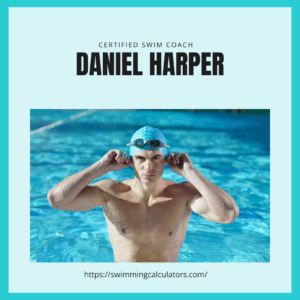
Daniel Harper
I’m Daniel Harper, a certified swim coach and aquatic fitness instructor with over 12 years of experience helping adult beginners build confidence, comfort, and skill in the water. I specialize in teaching swimming to non-competitive adults, first-time swimmers, and individuals who are working to overcome fear or anxiety in the pool.
Through my work with SwimmingCalculators.com, I help swimmers train smarter, track progress with confidence, and turn swimming into a sustainable, lifelong fitness habit—no matter where they’re starting from.