For a long time, I kept my swimming training plan in my thoughts. I promised myself I would “swim three times a week.” I would go a little longer or faster when I felt good and rest when I felt weary. That worked sometimes. Most of the time, it didn’t work. Progress seemed unpredictable, my desire came and went, and I never really knew whether my training was working.
When I stopped guessing and began utilizing actual numbers, everything changed. Here is a comprehensive blog post regarding the swimming training.
A swimming training plan doesn’t have to be hard to follow, but it does need to be able to be measured. You get more clarity when you organize your training based on time, distance, pace, and recuperation, not just how you feel. You know what you’re working for, how to change things up when life gets crazy, and when you’re really making progress.
The following guide teaches you how to make a swimming training plan with actual figures, even if you coach yourself, don’t have a lot of time, or are still getting used to the water.
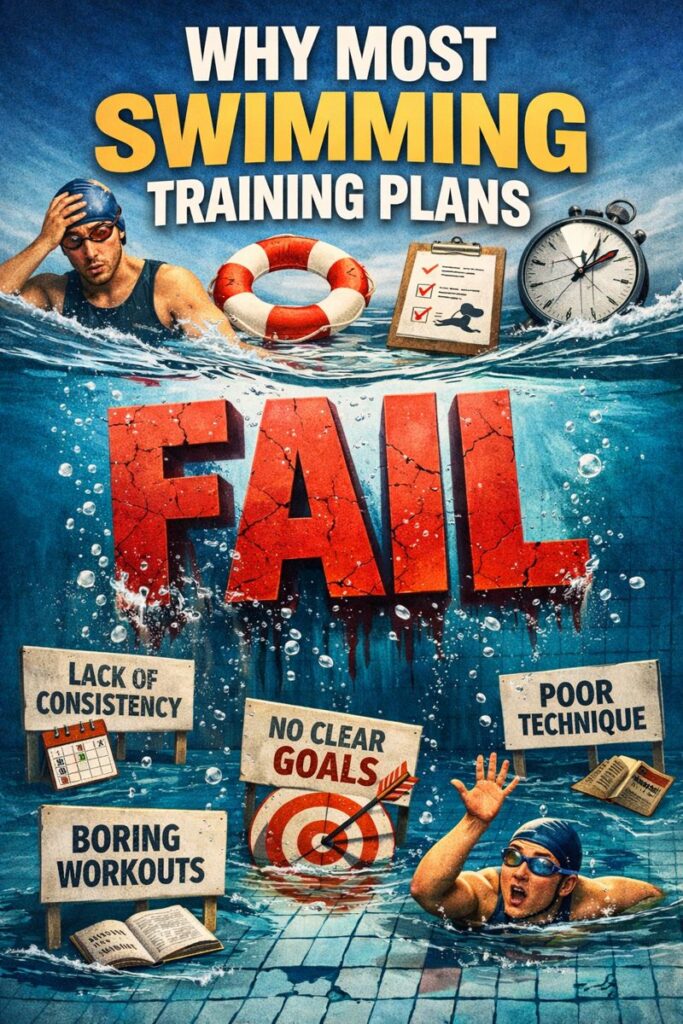
Why Most Swimming Training Plans Fail
Most swimmers don’t fail from lack of willpower. They fail because their plan is vague—full of intentions, not numbers.
“I’ll swim more.”
“I’ll try to go faster.”
“I’ll see how I feel.”
Those aren’t plans — they’re hopes. A plan needs measurable anchors so you can make consistent decisions even when motivation or time in the pool is limited.
Without numbers, you can’t reliably know:
- Whether you’re improving
- When to increase difficulty
- When to back off and prioritize rest
- Why you feel stuck, tired, or burned out
A good swim training plan removes emotion from decision-making. It gives you anchors—clear numbers for time, distance, pace, and rest that guide every session and let you compare workouts, not moods.
What “Real Numbers” Mean in Swim Training
Using real numbers isn’t turning swimming into math class. It means grounding your swim training in objective markers you can measure, repeat, and learn from.
The most useful numbers in swimming are:
- Time — session length or specific interval minutes (example: 45 minutes warm-up + main set)
- Distance — per repeat, per set, per session or per week (example: 1,200m per session)
- Pace — how fast you swim a repeat (example: 1:40/100m); used in zones for consistency
- Frequency — how many sessions per week (example: 3×/week)
- Progress trends — small changes over time, not single workouts (example: 2 seconds faster over 4 weeks)
When time, distance, pace, frequency and trends work together, training becomes predictable and sustainable. Use simple intervals (repeats × distance @ target pace + rest in seconds) and log minutes and seconds so you can visualize progress in a spreadsheet or tracker.
Step 1: Define Your Actual Swimming Goal (Not a Vague One)
Before you design a plan, ask one clear question:
What do I want my swimming to do for me in real life?
Good goals are specific, measurable, and time‑bound. Examples that work:
- Swim 1,000m continuously without stopping (within 12 weeks)
- Improve 100m time by 10 seconds
- Finish a charity open‑water swim comfortably
- Maintain fitness with 3 efficient sessions per week
Bad goals are vague and unmeasured:
- “Get fitter”
- “Swim better”
- “Not feel tired”
Your chosen goal determines what numbers matter most in your swim training plan—distance and endurance for continuous swims, pace and intervals for time‑based targets, or frequency and technique for general fitness.
Quick micro‑tutorial: convert a vague goal to a measurable one
- Vague: “Get fitter” → Measurable: “Swim 1,200m in 35 minutes, 3×/week”
- Vague: “Swim better” → Measurable: “Drop 5s from my 100m time in 8 weeks”
If you want help turning your goal into numbers, use the Swim Goal Tracker I recommend—then set one measurable goal today and schedule the first baseline test.
I often use the Swim Goal Tracker to turn vague goals into measurable ones.
Step 2: Establish Your Baseline (Your Starting Numbers)
A training plan should never start from zero or from someone else’s ability. Start with a few simple tests that tell you exactly where you are in the pool.
I recommend establishing a simple baseline using one or more of the following:
Option 1: Timed Continuous Swim
Swim continuously for:
- 200m or 400m (beginners)
- 800m or 1,000m (intermediate)
How to record results (micro‑template):
- Total time (mm:ss)
- Average pace per 100m (mm:ss)
- Perceived effort (easy/moderate/hard)
- Recovery time until you feel ready again (minutes)
Safety note for beginners: warm up for 5–10 minutes, stop if you feel dizzy or unwell, and consult a coach or doctor if you have any health concerns.
Option 2: Short Repeat Test
For example:
- 5 × 100m at steady effort
- Same rest between each (e.g., 20–30 seconds)
What to look for:
- Pace consistency (are repeats similar?)
- Fatigue patterns (which repeat drops off first?)
How to record results (micro‑template):
- Repeat times (mm:ss), rest in seconds
- Average main‑set pace (mm:ss/100m)
- Notes on which repeats felt hard
Option 3: Perceived Effort (RPE)
Especially useful if you’re newer or don’t have precise timing tools. Use three simple zones:
- Easy — could swim much longer (RPE 2–3)
- Moderate — focused but controlled (RPE 4–6)
- Hard — short duration only (RPE 7–9)
How to record results (micro‑template):
- Session length (minutes)
- Main‑set description and perceived effort
- Recovery notes (how long until breathing normalizes)
Practical notes: if you swim in a 25m vs 50m pool, times will differ — track the pool length, and account for extra turns. Use a pull buoy or simple kick set in baseline sessions only if that matches your usual swim technique.
Your baseline is not about ego. It’s about accuracy. Record minutes and seconds, rest intervals in seconds, and a short note on how the water felt that day. Those numbers give you the starting blocks for a plan that fits your ability.
Step 3: Decide How Many Days You Can Realistically Swim
This is where many plans fall apart: good intentions meet busy lives. Pick a frequency you can maintain consistently—consistency beats sporadic intensity.
I’ve seen far more success from swimmers who commit to 2–3 consistent sessions per week than from those who aim for five and manage one or two.
Here’s a realistic framework and who it fits:
- 2 days/week → Maintenance and slow improvement. Good for busy parents or athletes balancing other training; keep sessions focused (technique + steady endurance).
- 3 days/week → Noticeable progress. Ideal for commuters or recreational swimmers who can hit the pool Mon/Wed/Sat with clear session purposes (technique, threshold, speed).
- 4+ days/week → Performance‑focused training. Fits competitive swimmers or athletes targeting a race, where you can add specialized sets and recovery work.
Example weekly slotting for a 3‑day plan:
- Mon — Technique + easy endurance (pool time: 40–50 minutes)
- Wed — Threshold / steady pace work (main set with intervals and controlled rest)
- Sat — Speed or progression focus (shorter repeats, faster effort)
Practical tips: schedule sessions around your week so they’re non‑negotiable, factor in rest days, and keep one session lighter when life gets busy. Choose pool sessions that match your goals—if your aim is endurance, prioritize longer steady sets; if it’s race pace, prioritize interval work with specific seconds of rest.
Your plan should fit your life, not fight it.
Step 4: Structure Your Weekly Training Using Numbers
Once your frequency is set, structure the week so each session has a clear purpose. Don’t just swim—assign a role to each pool visit and give it numbers (duration, distance, pace, rest).
Example: 3-Day Training Plan (Balanced)
- Session 1: Technique + easy endurance — focus on drills and smooth freestyle, moderate distance at easy pace.
- Session 2: Threshold / steady pace work — controlled intervals to build sustainable speed and aerobic capacity.
- Session 3: Speed or progression focus — shorter repeats, faster efforts, or a progressive main set that finishes faster than it starts.
Each session should include measurable targets:
- A target duration (e.g., 40–50 minutes)
- A target distance range (e.g., 1,200–1,500m)
- A target effort or pace (e.g., main set at threshold pace with 20–30 seconds rest)
Short numeric sample (3‑day):
- Session 1 — Technique & Easy Endurance: 45 min / 1,200m (warm‑up 10 min, drills 10 min, 6 × 100m easy with 20s rest, cool‑down)
- Session 2 — Threshold: 50 min / 1,400m (warm‑up, 10 × 100m @ threshold with 20s seconds rest, plus drills)
- Session 3 — Speed/Progression: 40 min / 1,000m (warm‑up, 8 × 50m fast with 30s rest, 4 × 100m negative split)
Use clear set notation when you write workouts: repeats × distance @ target pace + rest (for example, 10 × 100m @ threshold with 20s rest). That format makes swim workouts easy to follow and compare across sessions. Adjust distance and seconds rest to match your pool and ability.
This approach prevents the trap of doing every session at the same moderate intensity. Instead, each pool visit has purpose and measurable progress can be tracked.
Step 5: Break Each Session Into Measurable Parts
Every effective swim session follows the same pattern: warm‑up, main set, cool‑down. Give each part numbers so you can plan, execute, and compare workouts.
Warm-Up (10–15 minutes)
Measured by:
- Time or distance (e.g., 8–15 minutes, 200–400m)
- Easy pace, drills and movement prep
Purpose:
- Prepare joints, lungs, and muscles for work
- Establish breathing rhythm and stroke feel (include some kick and drill reps)
Main Set (The Purposeful Work)
Measured by:
- Repeats × distance (e.g., 8 × 100m)
- Target pace (e.g., 1:40/100m or a zone)
- Rest intervals in seconds (e.g., 20s rest)
Purpose:
- Improve a specific quality—endurance, threshold pace, or speed/neuromuscular work
Examples of main‑set notation you can copy: “8 × 100m @ race pace with 20s rest” or “5 × 200m steady with 30s rest.” Use intervals and set structure to control effort—shorter repeats with short seconds rest train speed, longer repeats with longer rest build endurance.
Cool-Down (5–10 minutes)
Measured by:
- Time or distance (e.g., 5–10 minutes, 100–300m)
- Very easy effort
Purpose:
- Recovery and gradual heart‑rate reduction
- Reinforce technique and loosen the body (easy drills, gentle freestyle)
If a session doesn’t include these parts, it’s not a structured workout — it’s just swimming. Add small, concrete elements like a 5–10 minute warm‑up with kick and drills, a main set written as sets × distance @ pace + seconds rest, and a 5–10 minute cool‑down to make every swim a measurable training session.
Step 6: Use Pace Intelligently (Without Obsessing)
Pace isn’t about racing the clock every time. It’s about repeatability—hitting the same effort reliably so workouts stack into progress.
Think of pace in practical zones for swim workouts:
- Easy pace → recovery and volume (longer sets, easy effort)
- Sustainable pace → endurance building (steady intervals)
- Challenging pace → improvement stimulus (race‑pace practice)
- Fast pace → neuromuscular speed (short repeats, full effort)
You don’t need perfection—consistency matters far more than hitting a perfect split once. Use pace to make sets repeatable: pick a target and aim to hold it across repeats, adjusting rest in seconds so you can meet that target.
Quick example: if your 100m test is 1:40, a sustainable pace might be 1:45–1:50 for 6 × 100m with 20s rest; race pace for shorter reps could be 1:38 for 8 × 50m with 30s rest. Note pool length—times in a 25m pool will often be faster because of more turns.
Use intervals (repeats × distance @ target pace + seconds rest) to control effort. For instance: 10 × 100m @ sustainable pace with 20s rest, or 12 × 50m @ race pace with 30s rest.
The Swim Workout Calculator helps estimate realistic paces from your current ability and makes setting these zones easier.
Step 7: Plan Progression (So You Don’t Plateau)
A plan without progression is just repetition. If you want continued improvement, change one variable at a time so your body adapts without getting overloaded.
Progression can be achieved by adjusting a single variable, for example:
- Increase total distance slightly (add 5–10% to weekly meters)
- Reduce rest between repeats (trim 5–10 seconds)
- Improve pace consistency across repeats
- Add one extra repeat to a key set (for example, 8 × 100m → 9 × 100m)
Never change everything at once—small, measurable changes are sustainable and trackable.
A simple illustrative mini‑plan (4 weeks):
- Week 1 — Baseline: record weekly distance and a key set (e.g., 6 × 100m @ target with 30s seconds rest).
- Week 2 — Progression: reduce rest by 5 seconds (e.g., 25s rest) while keeping pace targets the same.
- Week 3 — Add volume: add one repeat to the main set or increase total weekly distance by 5–10%.
- Week 4 — Recovery: drop intensity and volume (lighter week) to let adaptation consolidate.
Track simple metrics—weekly distance, target rest in seconds, and average set pace—so you can see trends and avoid plateau. Use intervals and set structure (repeats × distance @ pace + seconds rest) to make progression exact and repeatable.
I usually recommend a 2–3 week progression block, followed by a lighter week to recover and lock in gains.
Step 8: Track What Actually Matters
Tracking is not about judgment — it’s about feedback you can act on. Record a few high‑value metrics consistently and you’ll see real trends instead of guessing.
What I track consistently:
- Total distance per session (meters)
- Average pace per main set (mm:ss / 100m)
- Rest intervals (seconds rest between repeats)
- Perceived effort (RPE or easy/moderate/hard)
- Short notes on fatigue, confidence, or unusual conditions (pool temperature, illness)
Quick example tracking row you can copy (one line per session):
- Date | Pool length | Total distance | Main set avg pace | Rest (s) | RPE | Notes
Minimum cadence: track every session if possible, or at least every main set. Export weekly totals to spot progress trends—distance per week, average main‑set pace, and changes in rest (seconds) are especially informative for endurance vs. race goals.
Tools I regularly recommend:
Practical tracking tips: include pool length (25m vs 50m) because turns affect pace; note when you used a pull buoy or did extra kick sets; and log recovery notes (how many minutes until you felt ready for the next session). Tracking these few items—distance, sets, seconds rest, pace, and RPE—makes progress visible, fuels motivation, and helps you decide whether to push a bit harder or prioritize recovery.